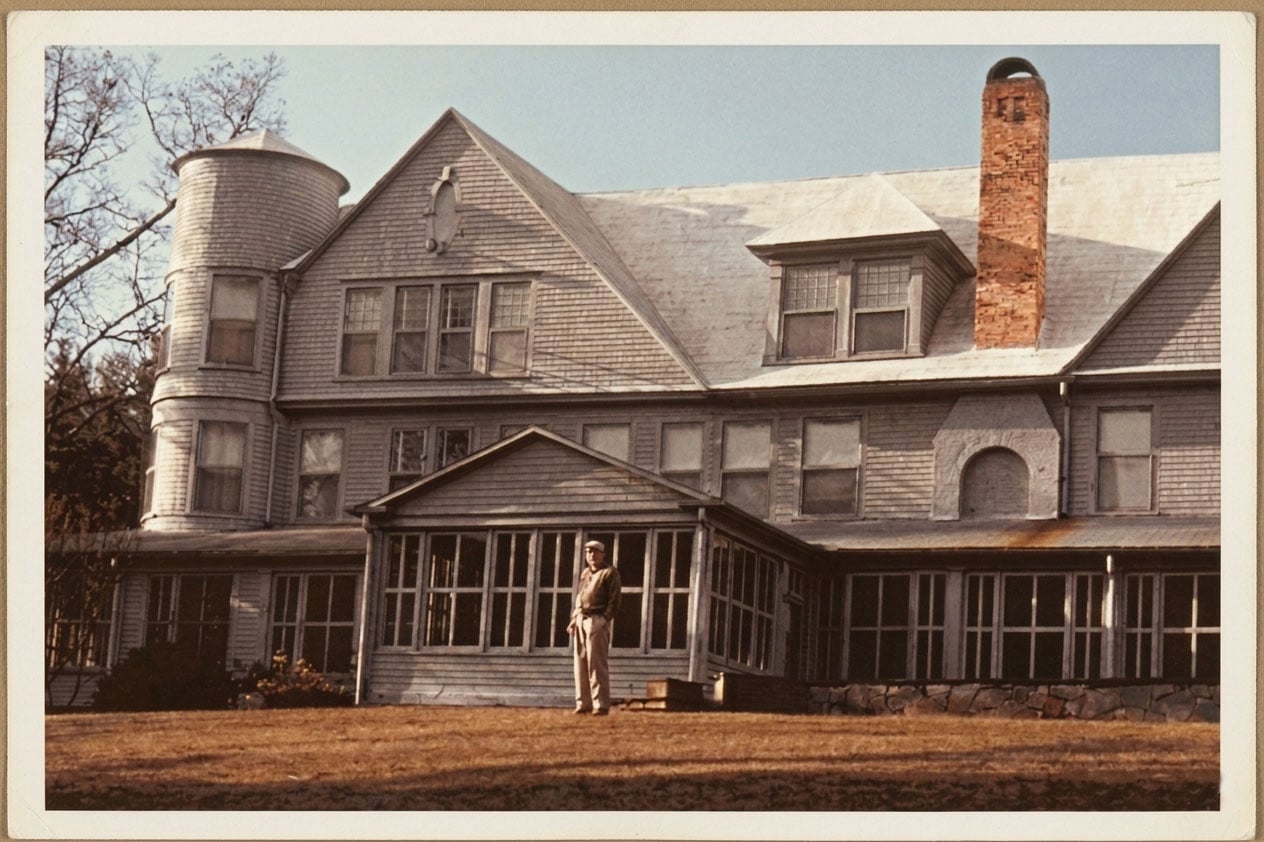
1954 - Gene Howerdd, Sr. in the back of Fairfield Inn
1954 - 1970's
The transformation of Sapphire Valley from a rugged wilderness into a premier mountain destination is the legacy of Gene M. Howerdd Sr. A man of immense logistical talent and corporate foresight, Howerdd didn't just build a resort; he engineered a community that balanced the preservation of the Blue Ridge landscape with the sophistication of modern leisure.
1954 - Gene Howerdd, Sr. in the back of Fairfield Inn
The Early Years: A Master of Industry
Born in Vicksburg, Mississippi, on August 14, 1906, Eugene M. Howerdd Sr. established himself early as a preeminent expert in the hardwood lumber industry. His expertise led to a recruitment by the Georgia Hardwood Lumber Co. (the future Georgia-Pacific Corporation), prompting a move to Augusta, Georgia, in 1933.
A Critical Contribution: The War Effort
Long before he shaped the landscape of North Carolina, Howerdd played a vital role in national security. As Vice President of Georgia Hardwood during World War II, he was tapped by the U.S. Army Engineers to solve a critical supply chain crisis.
The Logistics Challenge: The Army struggled to secure enough lumber for immediate shipment and lacked the necessary infrastructure for storage and distribution.
The Early Years: A Master of Industry
Born in Vicksburg, Mississippi, on August 14, 1906, Eugene M. Howerdd Sr. established himself early as a preeminent expert in the hardwood lumber industry. His expertise led to a recruitment by the Georgia Hardwood Lumber Co. (the future Georgia-Pacific Corporation), prompting a move to Augusta, Georgia, in 1933.
A Critical Contribution: The War Effort
Long before he shaped the landscape of North Carolina, Howerdd played a vital role in national security. As Vice President of Georgia Hardwood during World War II, he was tapped by the U.S. Army Engineers to solve a critical supply chain crisis.
The Logistics Challenge: The Army struggled to secure enough lumber for immediate shipment and lacked the necessary infrastructure for storage and distribution.
The Howerdd Strategy: He proposed utilizing the Lumbermens Merchandising Corporation (LMC) as a strategic hub for military distribution. Regulation OPA215: Working directly with officials in Washington, D.C., Howerdd helped draft Regulation OPA215, which officially designated LMC yards as "distribution yards" authorized to handle massive carloads of lumber specifically for the War Department.
The Catalyst for Sapphire Valley
The Howerdd family’s love affair with the North Carolina mountains began in the early 1940s. They were seasonal fixtures in Highlands, eventually purchasing a home overlooking the dramatic vistas of Horse Cove and Cashiers Valley.
By the early 1950s, two factors converged to change the course of the valley’s history:
The Move West: Georgia-Pacific announced it would relocate its headquarters to Portland, Oregon.
Access to the Greens: Howerdd realized that local golf access was becoming increasingly restricted to those who owned land directly adjacent to the clubs.
Choosing retirement over a move to the West Coast, Howerdd decided to build his own sanctuary. If he wanted to play golf with his friends in the mountains he loved, he would have to build the course himself.
The 1954 Acquisition: A Legacy Reclaimed
In 1954, the Howerdd family acquired a staggering 8,500-acre tract in Sapphire. This land carried a storied pedigree, born from the dissolution of the original 250,000-acre Lake Toxaway estate following the 1916 dam failure.
The property was purchased from the Tatum family (owners of the Tatum Surf Club in Miami), who had operated the land as the
Tatum Sky Club.
The acquisition was divided into two distinct sectors:
The North Side (Hwy 64): Approximately 6,500 acres encompassing the historic Fairfield Inn and the 200-acre Lake Fairfield.
The South Side (Hwy 64): Roughly 2,000 acres of varied terrain and former farmland—the future site of the resort's athletic centerpiece.
Building a Masterpiece: The 1950s and 60s
To realize his vision, Howerdd hired George Cobb, a luminary in golf course architecture and a former Marine Corps Major. Cobb, who had previously co-designed courses at Camp LeJeune, was tasked with carving a world-class course out of the 2,000-acre southern tract.
The development was officially christened The Sapphire Valley Inn and Golf Club, opening in 1956. Under the Howerdd family’s management until 1970, the valley saw the birth of its foundational residential communities:
Golf Club Estates & Sapphire Cottages
Country Club Apartments
Round Hill Estates
Hogback Lake Estates