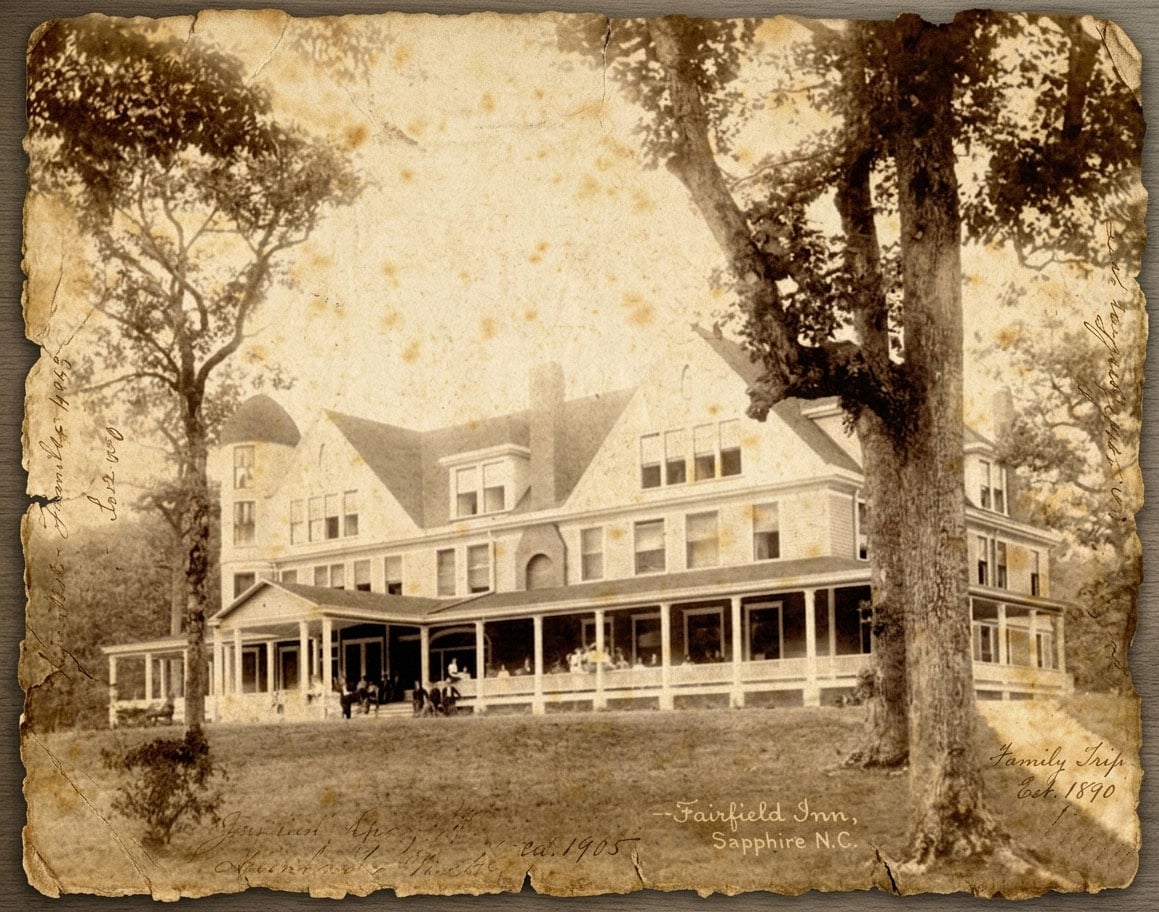
ABOUT THE INN
Nestled in the heart of Jackson County’s "Sapphire Country," the Fairfield Inn served as a premier mountain destination for 90 years. Built between 1896 and 1898 on the shores of Fairfield Lake, the inn was the first great achievement of the Toxaway Company, a venture that transformed Western North Carolina into a national tourism hub.
Architectural Grandeur
The inn was a masterpiece of Queen Anne style resort architecture, designed to evoke the charm of a Swiss alpine lodge.
Distinctive Silhouette: The 2.5-story frame building featured three massive shingled gables, hipped dormers, and a prominent three-story corner turret.
Artistic Details: Its exterior was accented by elegant elliptical windows and a diverse mix of textures, including overlapping weatherboard and decorative shingles.
Lakeside Features: A one-story verandah stretched across the lakeside facade, offering guests sweeping views of the water and surrounding peaks.
Historical Significance & Gold Roots
The Gold Era: The inn was constructed near the site of the Georgetown Mine, a former gold and gem mining operation that was later flooded to create Fairfield Lake.
Toxaway Venture: Founded by Edward H. Jennings and the Toxaway Company, the inn was the "proving ground" for their later luxury projects, such as the Toxaway Inn.
Elite Heritage: Added to the National Register of Historic Places in 1982, it stood as one of the few grand hotels from the "Golden Age" of mountain tourism to survive into the late 20th century.
Modern Updates & The Howerdd Era
In 1954, retired executive Gene Howerdd Sr. purchased the property, initiating the only significant modifications in the inn's history.
Luxe Upgrades: Howerdd installed an elevator salvaged from a grand hotel in Palm Beach and added private baths to guest rooms by repurposing closet space.
Social Spaces: The lakeside porch was glassed-in to create the popular Library Lounge, while the back porch was covered to expand the formal dining area.
Infrastructure: The kitchens were modernized, and the 100-room facility received periodic aesthetic updates to maintain its high-service standards.
A Tragic End & Legacy
One story goes like this: What the press was fed: Despite its enduring presence, the inn's story ended in 1986. A fire broke out that year, and while the building survived the initial flames, the damage revealed structural safety issues. Deemed unsafe for renovation, the historic structure was demolished later that year. Today, the site remains a symbolic heart of Sapphire Valley, remembered for its "Golden Age" elegance and its role in putting the region on the national map.
The real story, witnessed by many: By 1983, Fairfield Communities from Little Rock finished building River Run, a new 'hotel' and townhome project. They wanted to keep all guests near the new main desk and restaurant, which is now Micas Mountain Kitchen.
The old Fairfield Inn was left behind and used for employee housing.
The Demolition of the Inn - 1986
Fairfield Communities promised to build a new Victorian hotel on the site.
Crews wrapped steel cables around the four corners of the old building.
They pulled the cables until the structure crashed down around its center.
A single beer bottle sat untouched on the Library Lounge bar the next day.
After the Collapse
Fairfield Communities ran into money troubles soon after the destruction. They never built the new hotel they promised. The empty land left a major mark on the history of the resort property.